The Impossibility of Knowing Everything
Information security encompasses vast and diverse domains. Trying to learn everything is an impossible quest. Let's examine a concrete example to understand why.
Imagine you decide to learn every one of the 200+ programming languages in existence to understand how applications can be compromised through debugging or reverse engineering. If each language required 100 hours of study, you would spend 20,000 hours — roughly seven years full-time — just to master the languages. And that's before you even practice debugging or reverse engineering. Adding those skills would double the commitment again.
It's absurd. No one wants or can function that way.
Thinking Through Fundamental Principles
The solution lies in a different approach: focus on universal principles rather than individual variations.
All programming languages, despite their differences, rest on the same structural principles first defined by R. D. Tennent:
- The Principle of Abstraction — the ability to hide internal complexity
- The Principle of Correspondence — the link between abstract concepts and implementation
- The Principle of Data Type Completeness — consistency in the structures being used
Deeply understanding these principles in a single language lets you learn others far more quickly. You don't need to master 200 languages to read and analyze code. Principles transcend tools.
In information security, this approach is essential. You must rapidly gain solid understanding of fundamental structures and processes, then adapt these insights to each new environment you encounter.
Embracing the Unknown
There will be many situations where you don't understand how something works. That's normal. That's even desirable.
At those moments, your task is clear: identify exactly what you don't know, then fill that gap. This ability — recognizing a hole in your understanding — is a skill itself, and it develops through practice.
Key concept
The best professionals aren't those who know everything. They're the ones who know how to find and rapidly integrate what they don't know.
Community: Learning Together
Many information security learning communities exist and offer free resources: application reviews, vulnerable machines, guides, and member-to-member exchange.
When you interact with others in these spaces, you'll notice two types of people:
- Those who don't realize they know nothing
- Those who know they don't know much
This diversity can be frustrating, but it's a normal part of collective learning. Mutual respect is crucial: we all started from zero. At Hack The Box, community resources include the forum and Discord server.
Assessing Your Own Level
A common trap: misjudging your own skills. Penetration testers must master a wide variety of technologies — and this same diversity makes self-assessment difficult.
You might be expert in one domain and completely novice in another. The question isn't whether to become expert everywhere (impossible), but how to choose a conscious learning strategy.
Two approaches exist:
- Learn a little of everything → risk mastering nothing
- Become expert in one domain → good depth, but narrow coverage
The true key is a third path: develop a learning methodology — learn how to search, how to filter, how to learn fast, and how to rapidly adapt that knowledge to your current context.
Active vs. Passive: How to Actually Progress
There's a fundamental distinction between two forms of learning.
Passive learning means consuming: reading books, watching tutorials, listening to explanations. This helps you understand concepts.
Active learning means practicing: writing code, configuring systems, testing your hypotheses, making mistakes. This is how you develop real, practical skills.
Example: you can read 50 books on programming and know how to read code (passive). But writing your own program is entirely different — that requires active practice.
warning
A good penetration tester doesn't emerge from reading. He emerges from sustained, repeated practice. There is no shortcut.
The Central Question: When Are You Good Enough?
You'll inevitably ask yourself: "When am I skilled enough to operate as a penetration tester?"
The answer can't be "when I've learned everything" — that moment will never arrive.
It's rather: when you master three key abilities.
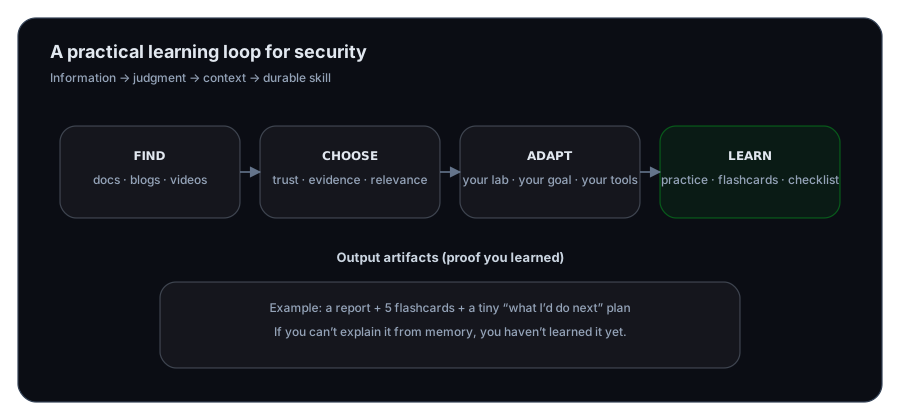
- Find — locate relevant information on the internet
- Choose — distinguish what's useful from what isn't
- Adapt — apply that information to your specific context
But there's one crucial element missing. Can you guess what it is?
The missing term is: LEARN.
Not learning facts, but learning how to learn. That's different. And it's hard.
Learning How to Learn
In school, the typical pattern is this: a teacher shows you one way to solve a problem, explains it, then gives you exercises to practice that single approach.
But in the real world, to progress rapidly, you must think differently. Take this simple math equation:
20 * ________ + ________ = 65535
It's easy to solve. But have you considered how many different paths could lead to the answer?
Most people use a single strategy without examining it. Why did you choose your method? What other approaches exist? Which is most elegant, fastest, most adaptable to a slightly different problem?
This curiosity — this willingness to explore multiple paths — is what separates genuine learning from mere repetition.
Why can't we learn every programming language that exists?
What are the three universal principles of programming languages?
What's the difference between passive and active learning?
What are the three key terms for becoming a good penetration tester?
What is the fourth missing term that completes the list?
Why is misjudging your own skill level a common trap?
What does 'learning how to learn' mean in information security?
Why is mutual respect critical in learning communities?
Exercise 1 — Apply “Find → Choose → Adapt → Learn” to a real problem
Pick a small security topic you struggled with recently (example: “why does my exploit fail?”, “how does SSRF work?”, “what is an SPN?”) and do this:
- Find 3 sources (docs / blog / video)
- Choose 1 source you trust most and explain why
- Adapt: rewrite the explanation for your current context (your lab / your app / your goal)
- Learn: write 3 flashcards from your adapted explanation
Question 1 — What’s the key difference between passive and active learning for security?
Next Lesson
Now that you understand foundational thinking frameworks, the next lesson explores lateral thinking and how to challenge your assumptions.
Next: Outside-the-Box Thinking