What Is a Decision?
A decision is the choice of one option from several available options.
Sound simple? The reality is far more complex. Decision-making is an extensive subject with many competing theories and disagreements. Different models attempt to explain how humans decide, yet none completely captures the full complexity.
Here's what research confirms: all decisions are based on what you expect to gain, and this calculation is simultaneously rational and emotional.
Consider a practical scenario: You receive an unexpected day off. A friend asks for help moving. You're also working on a project for your employer that could lead to a salary increase.
Your choice depends on your values. If well-being matters more than income, you help your friend. If income matters more, you work on your project. Both are rational. The difference is what you prioritize.
Key concept
Decisions aren't purely rational calculations. They're evaluations of what matters to you, filtered through emotion, values, and priorities. This isn't a flaw—it's how decisions actually work.
Beyond Pure Rationality
Research in decision psychology has established something important: people don't behave exclusively based on cost-benefit analysis.
Many rationality models assume humans make decisions by calculating advantages vs. disadvantages, then choosing the maximum benefit. This model doesn't match reality. Humans consider costs and benefits, but also values, emotions, relationships, and priorities.
Rationality in human decision-making occurs only to a limited extent.
This doesn't mean humans are irrational. It means rationality is one component among many. Emotion, intuition, values, and context all shape decisions. This is normal. This is how humans actually decide.
The Trolley Problem: A Thought Experiment
The Trolley Problem is a famous ethical thought experiment that has puzzled philosophers, psychologists, and legal scholars for decades.
The scenario:
"A train speeds uncontrolled toward five track workers. You stand by a switch that diverts the train to a siding where only one person works. Should you sacrifice one person to save five?"
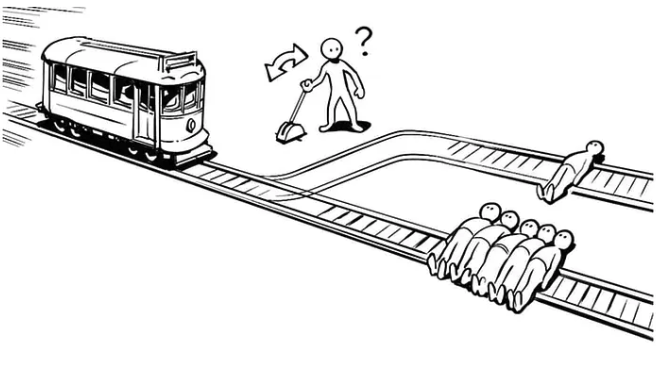
Over 70,000 people in 42 countries were surveyed on this dilemma. The results were published in the Proceedings of the National Academy of Sciences.
Researchers noted something important: the scenario is extreme. It creates enormous psychological burden. People cannot reasonably be expected to make such decisions. In fact, they called it essentially "impossible" to make a correct choice.
Why? Because the scenario appears to offer only two options:
- Switch the track → one person dies
- Do nothing → five people die
Both outcomes involve death. The "best" option still means someone dies. This is what makes it psychologically unbearable.
The Trolley Problem mirrors real decision-making constraints.
The Hidden Assumption
Here's where this connects back to our earlier math equation:
20 * ________ + ________ = 65535
Remember? You had only two apparent options:
- Place the smallest number in the first blank
- Place the smallest number in the second blank
Both approaches "work," but you felt constrained. Same with the Trolley Problem — it appears to offer only two choices.
But here's the critical insight: no one explicitly told you that you were limited to those options.
In the Trolley Problem, notice what immediately comes to mind:
- "But we're not allowed to place pillars"
- "We can only press the switch"
But who said this? No one. You imposed these limits on yourself.
It's like someone on the street telling you that you're not allowed to move while walking. You'd dismiss them and continue walking. Yet in abstract problem scenarios, people internalize these unspoken limits.
We set our own limitations, not others.Reframing the Trolley Problem
What if the scenario had additional information?
- How far away is the train?
- How fast is it traveling?
- How much time do we have?
- What tools are available?
- Are the people on the tracks conscious and able to move?
With different information, the problem transforms. If people have time and awareness, they can jump off the tracks. If you have tools, you have more options. If the train is far enough away, you have time to explore alternatives.
What seemed like an impossible binary choice becomes a problem with multiple solutions — none of them predetermined.
warning
Missing information doesn't mean missing solutions. It means you can't evaluate solutions yet. Gather the facts, and new possibilities emerge.
The Power of Information
Here's the central principle: the more factors you know, the more precise your decision becomes.
In the Trolley Problem, additional factors change everything:
- If everyone is conscious and aware, warn them to get off the tracks
- If you have time, explore creative alternatives
- If you have tools, create new solutions beyond the binary choice
Even extreme solutions become possible. In the extreme case where you have only seconds, you might flip the switch as the train passes over it — a "double-tracking" maneuver that derails the train rather than choosing which track it takes.
None of these solutions were apparent in the original problem statement. They emerged only when you questioned the limitations and gathered more facts.
Facts transform impossible decisions into solvable problems.
When Someone Says "Impossible"
When someone tells you something is impossible, they're making a statement about their own knowledge, not about reality.
That person simply cannot see all the factors involved. They don't see a solution, which means the solution isn't visible from their perspective. But that doesn't mean no solution exists.
Many people accept this statement from others, then transfer that attitude to themselves. They internalize the limitation: "If they say it's impossible, it must be impossible." Then they give up before trying.
This is premature failure. They fail before making any attempt because they accepted someone else's limitation as fact.
The Missing Pieces Problem
When you don't know what to do in a situation, the reason is usually straightforward: you haven't gathered enough facts to make a good decision.
This isn't a character flaw. It's not a limitation of your intelligence. It's simply missing information.
The solution is equally straightforward: gather the data. Once you have enough information, you can:
- Calculate likely outcomes
- Open up new possibilities
- Identify viable paths forward
- Make decisions with confidence
The difference between "impossible" and "solvable" is often just information.
Integration: The Four Foundations
Throughout this course, you've encountered four interconnected foundations:
- The Goal — a specific, challenging objective you've defined clearly
- The Will — commitment and effort to pursue that goal despite difficulty
- The Brain — understanding how your mind processes information, consciously and unconsciously
- Decision Making — gathering information to make choices that move you toward your goal
Success emerges when these align:
You decide (with full information) on a goal defined in detail (that resonates with your values), that you genuinely want to achieve (with commitment), and that will satisfy you consciously and subconsciously (aligned with your whole self)
.
When these four elements align, no one can question your success. Not because success is guaranteed, but because you've made the most informed, committed, intentional decision possible.
What is a decision?
Are decisions purely rational?
In the day-off scenario, what determines your choice?
What makes the Trolley Problem psychologically unbearable?
Who imposed the limits in the Trolley Problem?
How does additional information change the Trolley Problem?
What does it mean when someone says something is impossible?
Why do people often fail before trying?
When you don't know what to do, what is the usual reason?
What four foundations must align for success?
Exercise 1 — Make a learning decision with a simple framework
You have 3 options to study next (pick your own). For each option, write:
- Expected impact on your goal (high/medium/low)
- Time cost (hours)
- Proof of progress (what you’ll produce)
Then choose the best option and justify in 3 lines.
Question 1 — What’s the main danger of “intuitive” decisions while learning?
Next Lesson
Beyond rational decision-making, the next lesson teaches effective documentation and communication.
Next: Documentation Habits