The Mountain and the Forest
Imagine standing on a tall mountain. At the base, a vast forest stretches in all directions. On the horizon beyond the forest, another mountain — your destination.
The problem: once you descend into the forest, you can't see the destination mountain anymore. The trees block your view. You lose your overview.
To reach the distant mountain, you must navigate using intermediate points: lakes, rivers, fields, clearings. You need a map. You need orientation points. You need tools.
Without these, you'll wander the forest disoriented. You'll either lose your way completely or exhaust yourself backtracking to the first mountain to reorient.
This is the power of overview. With overview, you navigate purposefully. Without it, you wander and waste effort.
Overview Is Interconnected
We've mentioned "overview" repeatedly throughout this course because it's foundational.
- Learning Efficiency requires overview — understanding how information pieces fit together
- Occam's Razor requires overview — understanding which factors matter most
- Decision Making requires overview — seeing the full context before choosing
- Documentation requires overview — presenting the big picture immediately
- Organization requires overview — seeing where you are and where you're going
By working through the previous lessons, you've already started drawing your map. You've clarified your goal. You've understood how you learn. You've examined your beliefs and fears. Each exercise built understanding.
Now you need to apply this understanding systematically to real work.
Key concept
Organization isn't about having the perfect system. It's about maintaining overview so you don't get lost while pursuing your goal.
Why Organization Matters in Security
Penetration testing frequently involves complex, multi-stage work:
- Reconnaissance of multiple systems
- Enumeration across dozens of services
- Vulnerability identification and documentation
- Exploitation attempts (successful and failed)
- Privilege escalation chains
- Post-exploitation activities
- Lateral movement
- Report compilation
This happens over hours, days, or weeks. You discover information continuously. You pursue multiple threads simultaneously.
Without organization, you'll constantly search for information you've already gathered. You'll lose context. You'll duplicate efforts. You'll miss connections between findings.
Organization prevents waste.The Axe-Sharpening Principle
An inexperienced woodcutter spends 30 minutes sharpening his axe and 3 hours cutting down a tree.
An experienced woodcutter spends 3 hours sharpening the axe and 30 minutes cutting down the tree.
Both cut down the same tree. The difference is preparation.
The inexperienced woodcutter rushes into work with inadequate tools. This leads to inefficiency, wasted effort, and poor results.
The experienced woodcutter invests time upfront in preparation. This leads to efficiency, speed, and quality results.
Preparation determines execution.In penetration testing:
- Reconnaissance is your axe sharpening — gather comprehensive information
- Exploitation is your tree cutting — apply what you've gathered
Many penetration testers rush exploitation before completing reconnaissance. They're like the inexperienced woodcutter. They struggle. They miss vulnerabilities. They waste time.
The expert spends time on thorough reconnaissance, precise organization of findings, and systematic planning. Then exploitation becomes straightforward.
Preparation is not wasted time—it's invested efficiencyOrganization Systems
Many management and organization systems exist, each with strengths and weaknesses:
Scrum emphasizes iterative development in sprints, daily standups, and sprint reviews. Strength: clear iterations and team synchronization. Weakness: can feel rigid for individual work.
Agile prioritizes flexibility, responding to change, and continuous improvement. Strength: adapts to new information. Weakness: can lack structure without discipline.
ToDo-Lists are simple task tracking. Strength: straightforward, lightweight. Weakness: can become cluttered; doesn't show progress or priorities well.
Bullet Journal combines planning, tracking, and reflection. Strength: flexible, customizable, encourages reflection. Weakness: requires discipline to maintain.
Kanban visualizes work in columns (To Do, In Progress, Done). Strength: shows workflow visually; prevents overloading. Weakness: requires physical or digital setup.
Mind Mapping organizes ideas hierarchically around central concepts. Strength: shows relationships; brainstorms comprehensively. Weakness: can become chaotic with large amounts of information.
Each system has trade-offs. The "best" system is the one you'll actually use consistently.
warning
Don't spend weeks searching for the perfect organization system. Good execution with an imperfect system beats perfect planning with no execution. Choose something and commit to it.
Creating Your Own System
Rather than adopting a pre-made system wholesale, consider creating your own hybrid:
- Take elements you like from different systems
- Test them on real work
- Refine based on what works for you
- Iterate as you learn what's necessary
For penetration testing specifically, consider:
- Overview level: Map out your target systems and networks
- Planning level: Break reconnaissance into stages
- Execution level: Track what you've tested and results
- Documentation level: Organize findings by system/service/vulnerability
- Reporting level: Structure findings by severity and business impact
Your system should support these levels without creating excessive overhead.
Key Principles for Organization
Regardless of which system you choose:
1. Make It Visible
If your organization is only in your head, you don't have overview. Write it down. Use tools. Make your plan visible so you can see it, adjust it, and stay oriented.
2. Keep It Simple
Complex systems are abandoned. Simple systems are maintained. Simplicity is better than comprehensiveness.
3. Capture Information Immediately
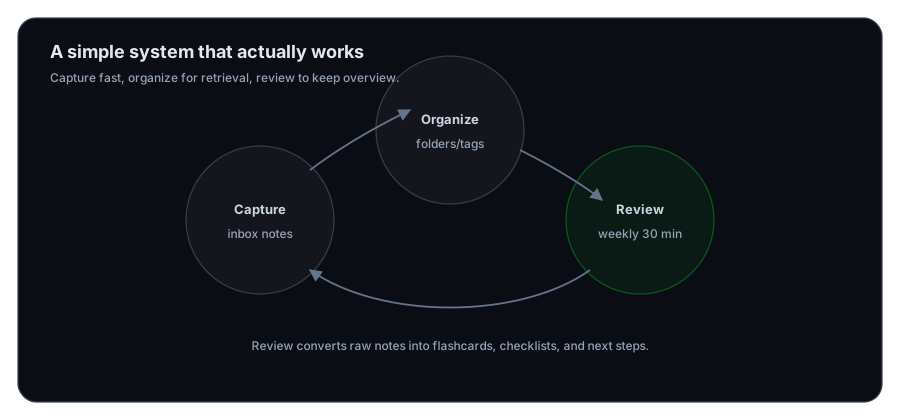
Don't try to organize everything perfectly. Capture findings, notes, and discoveries as they happen. Organize later.
4. Review Regularly
Daily or weekly, review what you've captured. Organize new information. Identify gaps. Plan next steps.
5. Adapt When Needed
If your system isn't working, change it. Systems are tools, not constraints. They should serve you.
Organization in the Learning Process
As you progress through security training:
Stay organized about your learning:
- What topics have you covered?
- What areas need deeper study?
- Which concepts are still unclear?
- What's your next learning objective?
Maintain a learning map similar to your penetration testing map. Know where you are and where you're going.
Document as you learn:
- Keep notes on what you discover
- Record questions as they arise
- Capture examples and solutions
- Link to resources
This becomes your personal knowledge base — invaluable for future reference and reinforcement.
Organization is maintenance of overviewWhat does the mountain-and-forest analogy teach about overview?
Why is overview interconnected with other concepts in the course?
What happens without organization during penetration testing?
What does the axe-sharpening principle illustrate?
In penetration testing, what is 'axe sharpening' and what is 'tree cutting'?
What are the strengths and weaknesses of Scrum?
What are the strengths and weaknesses of Agile?
How should you choose an organization system?
What are the five key principles for any organization system?
How should you organize your learning process?
Exercise 1 — Build a simple capture → organize → review loop
Set up:
- One “inbox” for quick capture (notes app / file / doc)
- One place for organized knowledge (folders/tags)
- One weekly review slot (30 min)
Question 1 — When does “organization” become procrastination?
Next Lesson
With organization established, the next lesson teaches deep focus as a strategic tool.
Next: Deep Focus