Why We Learn the Way We Do
Return to the equation from our first lesson:
20 * ________ + ________ = 65535
You solved it using familiar patterns. Why? Because you learned it that way.
We all do this. We apply patterns we've been conditioned to use, solutions we've practiced before, frameworks that feel comfortable. In moments of uncertainty, we default to what we already know.
This is both a strength and a limitation. The patterns serve us when they're appropriate. But they blind us when we need to see differently.
Thinking outside the box — the hacker's essential skill — means breaking free from these conditioned patterns. It means recognizing that the limitations we perceive aren't always real. Limitations are often perspective, not truth.
But here's what most people miss: thinking creatively and solving complex problems isn't purely intellectual. It's deeply emotional.
Problems Are Emotional States
Consider this statement carefully:
"A problem is an emotional state. Without emotions, it is just a situation."
This is profound. Think about what frustrates you. Is it the technical difficulty itself? Or is it the feeling that you shouldn't be struggling, that you should understand, that time is slipping away?
The technical situation remains the same. But your emotional relationship to it transforms everything.
When you encounter a concept you don't understand in penetration testing, you have two choices:
Choice 1: See it as a problem. Your emotional state becomes frustration, confusion, maybe inadequacy. This state clouds your thinking. You become less likely to explore creatively. You're more likely to give up.
Choice 2: See it as a situation. A neutral circumstance. Something you don't know yet. This emotional neutrality opens your mind. You can think more clearly. You can explore different approaches.
Key concept
The same technical challenge produces different outcomes depending on your emotional state. This isn't motivation psychology—it's a fundamental truth about how your brain works.
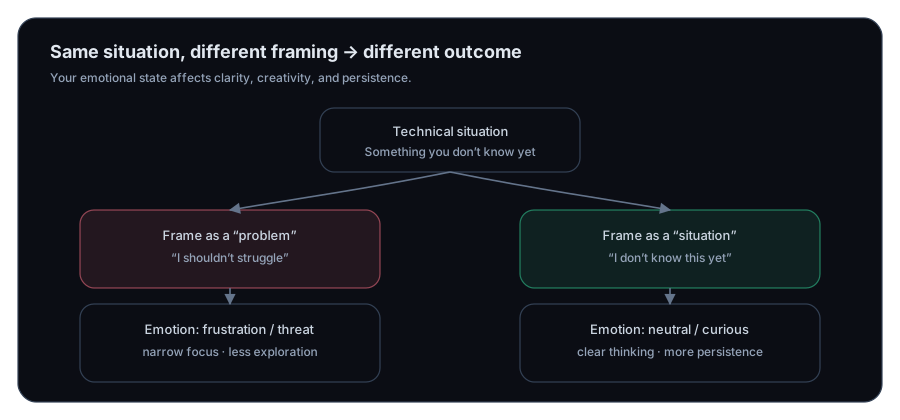
The learning process isn't purely theoretical or practical. It's deeply connected to your emotional state. Your success depends on how you feel about what you're learning.
If you approach learning believing you'll reach your goal, you often will. If you approach it expecting failure or insurmountable difficulty, that expectation shapes your effort and persistence.
The Power of Clear Goals
Now consider two scenarios.
Scenario 1: Your instructor says, "Move across the room." You start moving. An obstacle appears — a chair. What do you do? You might sit down. You might look confused. Without a specific goal beyond "move," the obstacle stops you.
Scenario 2: Your instructor says, "Move to that corner." You start moving. The same chair appears. What do you do? You go around it. You continue forward. You overcome the obstacle.
The only difference: knowing your goal.In the first scenario, without a clear target, the chair is an endpoint. In the second, it's merely an obstacle in a path you've already defined.
This applies directly to security learning. Many students encounter frustration because they don't have a clear goal. They jump from topic to topic — networking, then cryptography, then web vulnerabilities, then reverse engineering. Each topic feels disconnected. When they hit difficulty, they pivot to something else. They're constantly sitting down at chairs instead of moving around them.
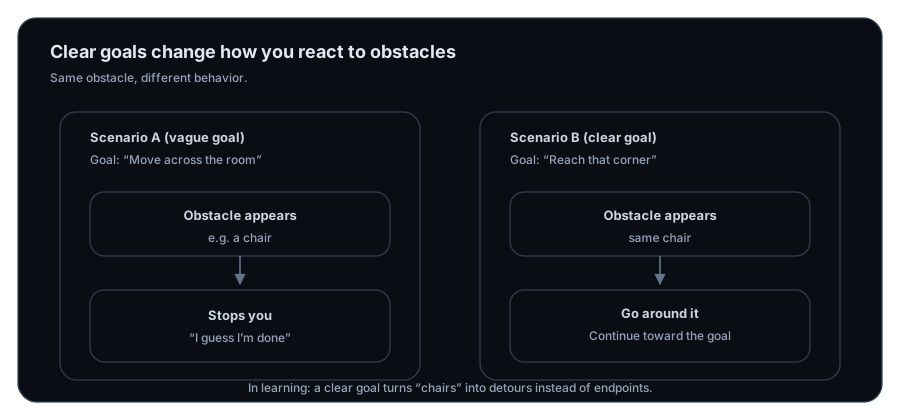
A clear goal transforms obstacles into challenges, not roadblocks.
Goal Clarity and Momentum
The scenarios illustrate why goal clarity matters so profoundly:
Without a goal, you're reactive. You move until something blocks you. You have no framework for deciding what to do next. The environment controls your decisions.
With a goal, you're strategic. You see the full path. Obstacles become expected — they're part of the journey, not surprises that derail you. You have a framework: "Does this approach move me toward my goal?"
This framework fundamentally changes how you learn. When you encounter a difficult concept, you ask different questions:
- Without a goal: "Is this too hard? Should I skip it?"
- With a goal: "Does understanding this move me toward my objective? If yes, I persist. If no, I defer it."
Both approaches involve obstacles. But one leaves you confused and scattered. The other keeps you oriented.
warning
Many students blame the material for being too difficult. The real issue is often unclear goals. Without knowing where you're heading, every detour feels like failure.
Your Emotional Foundation
Learning in security is challenging. You'll encounter unfamiliar technologies, complex concepts, and situations where you don't know what you don't know. This is guaranteed.
Your emotional state in those moments determines your trajectory. If you maintain:
- Belief that you can reach your goal — you persist through difficulty
- Clarity about what your goal is — you navigate decisions with purpose
- Neutral perspective on obstacles — you treat them as expected parts of the journey
...then difficulty becomes data, not a verdict on your capability.
If instead you carry:
- Doubt about your ability — difficulty feels like confirmation of that doubt
- Vague objectives — obstacles feel random and overwhelming
- Emotional reactivity to challenge — you abandon approaches too quickly
...then the same difficulty becomes demoralizing.
The technical content remains identical. Your learning outcome depends on your emotional foundation.
The Path Forward
As you progress through this course and your security journey:
-
Define your goal clearly. Not "learn penetration testing" but something specific: "Understand web vulnerabilities well enough to identify them in real applications" or "Master Python scripting for security automation." Specific goals are navigational.
-
Recognize obstacles as expected. Every goal has obstacles. This is normal. It doesn't mean you've chosen wrong — it means you're on the path.
-
Manage your emotional state. When frustration arises, pause. Recognize it as an emotional state, not a reflection of reality. Ask: "What am I frustrated about?" Often, it's not the technical difficulty but your expectation that things should be easier.
-
Maintain perspective. You're learning. You're supposed to encounter things you don't understand. That's how learning works.
Your emotions are data, not destiny.
Why do we solve problems using familiar patterns?
What does 'A problem is an emotional state' mean?
How does emotional state affect learning in security?
What is the main difference between the two room scenarios?
Why do many students jump between topics without depth?
How should you approach a difficult concept when you have a clear goal?
What transforms obstacles into challenges rather than roadblocks?
What are the three emotional foundations that support learning success?
Why does difficulty feel different depending on your emotional state?
What is the first step toward sustainable learning in security?
Exercise 1 — Turn a lesson into active recall
Pick any lesson you completed recently and:
- Write a 5-bullet summary from memory (no notes)
- Then reopen the lesson and correct your summary
- Convert the corrected version into 5 flashcards
Question 1 — Why is “re-reading” often a weak learning strategy?
Next Lesson
With emotional awareness as foundation, the next lesson covers efficient learning principles to maximize your progress.
Next: Efficient Learning