Focus Is a Double-Edged Sword
Focus is essential for achievement. It's also potentially limiting.
Focus is the deliberate concentration of your thinking and attention on a specific subject for a specific duration.
When you focus, all other thoughts fade. Your mental resources concentrate on one thing. This is powerful. It's also exactly the constraint that can blind you.
Earlier in this course, we emphasized thinking outside the box — questioning assumptions, exploring unconventional approaches. Focus, by definition, narrows your field of vision. It can create tunnel vision.
The skill isn't choosing between focus and flexibility. It's knowing when to focus narrowly and when to broaden perspective. It's managing the tension between depth and breadth.
Key concept
Focus is a tool, not a permanent state. Use it strategically. Broaden perspective when needed. Refocus when you've found your direction.
The Paradox of Physical Effort and Mental Calm
After a stressful day, many people immediately go to the gym. It seems illogical — they're already exhausted. Adding physical exertion should make things worse.
Yet they feel better afterward. Why?
Partially, it's biochemical. Exercise produces endorphins — neurochemicals that:
- Reduce pain perception
- Create a calming effect
- Improve sleep quality
- Regulate hunger
- Strengthen immunity (both physical and psychological)
But biochemistry only partly explains the effect. The real answer lies in focus.
During intense physical exercise, your mind must focus entirely on the activity. Your attention is consumed by your body's movement, breathing, and physical demands. This requires your complete focus.
When your focus shifts away from stress, something remarkable happens: your subconscious begins processing the stress autonomously.
Your conscious mind no longer holds the problem. It's released to the background, where subconscious processing can work on it without interference.
This is why you feel better. Not primarily because of endorphins, but because your conscious mind has been freed from obsessing over the stressor.
Refocusing transfers problems to subconscious processingThe Missing Keys Example
You've experienced this: you can't remember where you put something. You search consciously. Nothing. Frustration builds.
Then you stop searching. You turn your attention to something else — wash dishes, take a walk, work on a different task.
Suddenly, the answer arrives. "Oh! It's in the bedroom!"
Why? Because you stopped consciously searching. You stopped forcing the answer. You gave your subconscious the space to solve the problem.
This happens continuously with penetration testing challenges:
- You're stuck on a vulnerability. You can't exploit it.
- You step away. You work on something else.
- Hours later, the solution appears.
This isn't luck. It's subconscious processing. Your conscious obsession was actually preventing the solution.
Focus vs. Attention: A Critical Distinction
These words are often used interchangeably, but they're different.
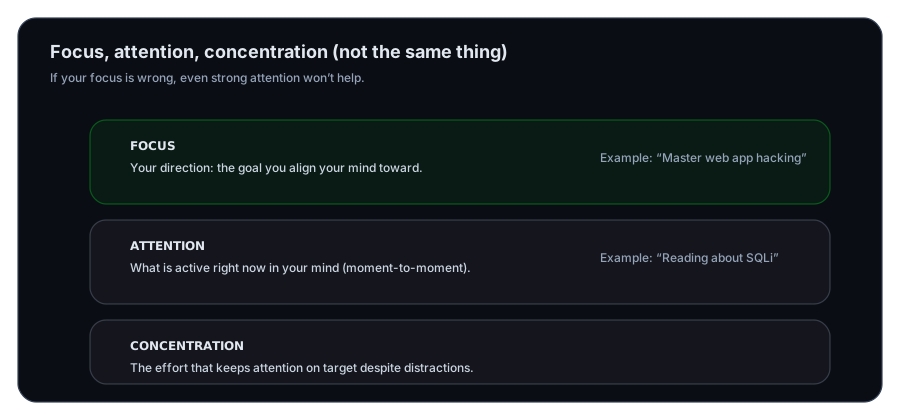
Attention is what's happening right now, in the moment. As you read this sentence, your attention is on the words. It's immediate and current.
Focus is the overarching direction of your thinking. Even while reading, your focus might be on "understanding focus" or "passing the exam" or "improving security skills." Focus is the bigger picture within which attention moves.
Here's a practical example:
You're searching for lost keys.
With attention on keys: "Where are the keys? Where did I last see them? Are they on the table? In my pocket?"
Your attention is actively on the search, moment by moment.
With focus on keys: Your entire thinking orientation is toward finding the keys. Your attention might wander — you think about breakfast, glance at your watch — but your focus brings you back: "The keys. I need to find the keys."
Now imagine you're in a hurry:
Attention: You're actively looking. You check your watch every 5 seconds.
Focus: You're focused on "being late," not on "finding the keys."
Even with strong attention to the search, your focus is misaligned. Your mind keeps pulling away toward the appointment. You'll struggle to search effectively because your focus — your deeper direction — is elsewhere.
Attention is influenced by focus. If your focus is wrong, even intense attention won't help.
warning
You can be fully attentive to the wrong thing. Focus determines what "right" means. Without proper focus, attention becomes distraction.
How Focus Shapes Action
Your focus is based on two things:
1. Your Will — what you consciously decide to pursue
2. External Influences — what the environment pushes you toward
Both shape your focus, sometimes constructively, sometimes not.
A conscious decision to focus is powerful. You decide: "My focus is mastering SQL injection." This conscious decision aligns your attention, effort, and energy toward that goal.
External influences can also shape focus — sometimes helpfully, sometimes not. A looming deadline focuses you. An interesting distraction defocuses you.
The skill is recognizing both and managing them intentionally.
Focused People Are Persistent
Focused people are remarkably persistent. They're not easily discouraged or distracted.
Why? Because their focus aligns with their goal. Every obstacle is seen in context of the goal, not as a random setback.
Compare two people encountering the same difficulty:
Person A (unfocused): "This is hard. Maybe I'm not good at this. Maybe I should try something else."
Person B (focused): "This is hard. I'm focused on mastering this skill. This difficulty is part of that process. How do I persist?"
Same difficulty. Different interpretations based on focus.
When you know your goal clearly and maintain focus on it, obstacles become expected. They're not detours — they're part of the path. This transforms persistence from willpower into natural consequence of focused direction.
Focus Multiplies Efficiency
Here's the practical impact: focused people reach goals much faster and aren't distracted by external influences.
Efficiency emerges naturally from focus. When your focus is clear, you:
- Recognize what's relevant — "Does this move me toward my goal?"
- Skip what's irrelevant — "Does this distract from my goal? I'll skip it."
- Persist through difficulty — "This is hard, but it's toward my goal."
- Make better decisions — "Which approach moves me toward my goal faster?"
All these flow from proper focus.
Unfocused people, by contrast:
- Question whether everything is relevant
- Follow every interesting tangent
- Abandon paths when they get difficult
- Make decisions based on immediate comfort
They're busier but less efficient.
Focus multiplies your velocity toward goalsThe Relationship to Goals
This connects directly back to earlier lessons:
- The Goal provides the target for your focus
- The Will provides the commitment to maintain focus despite difficulty
- Decision Making is improved by focus on your goal
- Organization systems help you maintain focus across complex tasks
Focus is the practical expression of your goal in action.
Without a clear goal, focus is impossible. You can't focus on something undefined. With a clear goal, focus becomes the natural alignment of your mental resources toward that goal.
Managing Focus for Security Learning
In your security journey:
1. Set a Clear Focus
Not "learn everything." But "master web application vulnerabilities" or "understand network reconnaissance" — something specific enough to focus on.
2. Recognize Attention vs. Focus
Your attention might wander (normal, healthy, even useful). But your focus should remain on your goal. Attention is flexible; focus is stable.
3. Use Focus Strategically
When you need depth — deep learning, complex problem-solving — intensify focus. When you need breadth — exploring new areas, thinking creatively — broaden focus.
4. Trust Subconscious Processing
When stuck, refocus elsewhere. Let your subconscious work on the problem. It often solves what your conscious mind couldn't force.
5. Recognize External Influences
Notice what diverts your focus. Social media, interesting tangents, perceived urgency. These are natural. Manage them deliberately rather than pretending they don't exist.
What is focus?
Why do stressed people often feel better after intense physical exercise?
How does refocusing help solve problems you were previously stuck on?
What is the difference between attention and focus?
In the lost-keys example, what happens when you're in a hurry?
How does focus influence attention?
What two things shape your focus?
Why are focused people remarkably persistent?
How does focus multiply efficiency?
What is the relationship between goals and focus?
Exercise 1 — Schedule two deep focus blocks this week
Plan 2 sessions (45–90 minutes) with:
- A single objective
- No notifications
- A “shutdown” ritual (write what you learned + next step)
Question 1 — Why does context switching feel small but cost a lot?
Next Lesson
With deep focus mastered, the next lesson teaches how to control and optimize your attention.
Next: Attention Control