The Information Overload Problem
Information security is vast. We've established this. But the problem isn't just size — it's integration.
Technical information exists everywhere. You can find courses, tutorials, documentation, and guides on every topic. The internet contains everything you need to succeed. That's not the bottleneck.
The real challenge is different: combining knowledge, adapting it to your context, and integrating new information with what you already know.
Even when you find relevant information, you face a dilemma: you don't know how to apply it. Why? Because you lack the bigger picture. You can't see how this new piece fits with everything else.
This creates a cascade of problems:
- You don't know what information you need
- You don't know what you don't know yet
- Even with information in hand, you can't contextualize it
- You're overwhelmed by the sheer volume
Key concept
The bottleneck in learning isn't information availability. It's the ability to integrate new information with existing knowledge and apply it effectively.
Learning Through Doing
Consider someone learning to assemble an engine.
The conventional approach: study engine theory first. Learn about combustion, valve timing, bearing tolerances, torque specifications. Build a theoretical foundation. Then attempt assembly.
The problem: theory without context is abstract. You memorize information without understanding why it matters or how it applies.
A better approach: start assembling under guidance.
Your instructor shows you the process. You work alongside them. You encounter problems in real-time. You ask questions as they arise, grounded in actual context. You see what works, what doesn't, what breaks, and why.
Then something critical happens: you fail. You realize you tightened something too hard. You didn't align a component correctly. You misunderstood a specification.
Failure is essential, not a setback. It's how you build experience. It's how you learn to handle unexpected situations. It's how your brain creates associations between theory and practice.
After assembling an engine with guidance, you understand assembly. You can now study the theoretical aspects in depth — not as abstract concepts, but as explanations of what you've already experienced.
Practice creates context for theory.
Reframing Competence
What does it mean to be "good" at something?
Being good means knowing what you're doing. Not memorizing information about it — actually understanding and applying it.
Knowledge alone isn't enough. Experience is the difference. Experience means you've encountered diverse situations and developed a vast repertoire of responses.
Where does this repertoire come from? From associations and practical experience. You've seen problems, attempted solutions, succeeded sometimes, failed other times. Each instance builds your mental catalog.
The question becomes: how much practice does competence require?
Enter the "10,000-Hour Rule." This concept suggests mastery requires 10,000 hours of deliberate practice. That's roughly five years at full-time work — or much longer if practicing in your spare time.
This sounds discouraging. Who wants to invest five years before becoming competent?
warning
The 10,000-Hour Rule is about mastery (excellence at the highest level), not competence (functional capability). The timescale for competence is much shorter.
The 20-Hour Rule
Security researcher Josh Kaufman examined this differently. His research suggests you can learn something new in 20 hours — even practicing just 45 minutes daily.
Twenty hours. Not 10,000.
The distinction: 20 hours gets you to functional competence in a new skill. You're not an expert. You're not at mastery level. But you can apply the skill effectively and continue improving.
This is dramatically more attainable. It means learning a new penetration testing technique might take 20 hours of focused practice, not years.
But here's where the insight deepens: not all 20 hours are equally valuable.
The 80/20 Rule
The Pareto Principle states: with 20% of effort, you achieve 80% of the effect.
Conversely, the remaining 20% of effect requires 80% of effort.
Applied to learning: 20% of what you learn produces 80% of your results. The fundamental concepts, core techniques, and essential frameworks generate most of your capability.
The remaining 80% of detailed knowledge? That generates only 20% of additional capability.
This doesn't mean ignore depth. Depth matters. But it means prioritization matters more. Focus on the 20% that moves you toward competence.
In penetration testing, for example:
- 20%: Understanding reconnaissance, vulnerability identification, and basic exploitation
- 80%: Everything else — edge cases, advanced techniques, tool mastery, theory
This framework explains why experienced practitioners seem to learn new domains quickly. They've already internalized the core 20%. New domains require mostly learning the surface variation of that same core.
Combining Approaches
Notice what we've done in this lesson: we've combined multiple concepts.
We started with the 10,000-Hour Rule (seems discouraging). We then introduced the 20-Hour Rule (more achievable). We then added the Pareto Principle (explains why 20 hours is sufficient).
These aren't contradictory. They're complementary:
- 20 hours gets you to functional competence (the 80%)
- 10,000 hours takes you to mastery and excellence (the remaining 20%)
- Most people benefit from becoming functionally competent across many domains rather than mastering one
This is how thinking works in security. You combine different mental models, frameworks, and research findings into a coherent understanding.
The Learning Pyramid
These principles connect to a well-researched model in education: the Learning Pyramid.
This framework shows retention rates across different learning methods:
- Lecture: ~5% retention
- Reading: ~10% retention
- Audiovisual: ~20% retention
- Demonstration: ~30% retention
- Discussion: ~50% retention
- Practice: ~75% retention
- Teaching others: ~90% retention
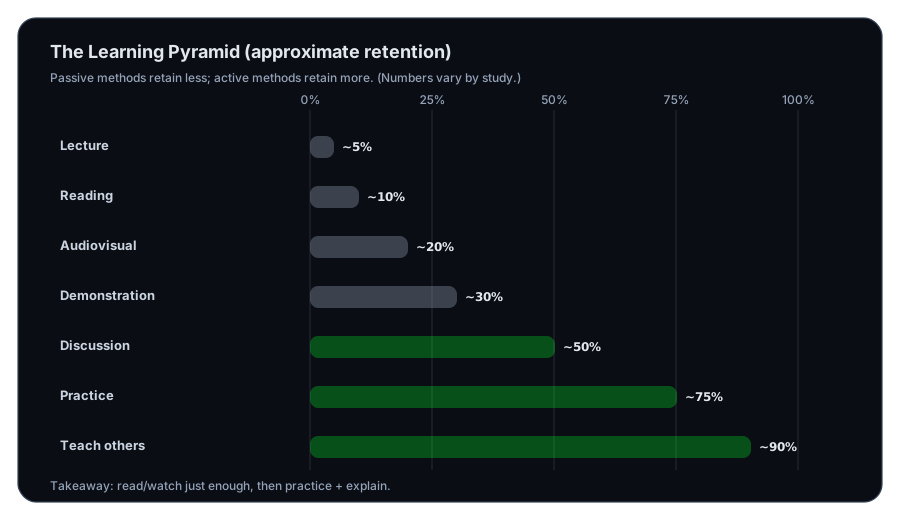
Notice the pattern: passive methods (listening, reading) generate poor retention. Active methods (practicing, teaching) generate strong retention.
This is why the assembly-engine-with-guidance approach works better than pure theory. It combines demonstration, practice, and discussion — all high-retention methods.
In your security learning, this means:
- Don't just read or watch. Read/watch minimally (10-20% retention), then practice.
- Practice actively. Work through challenges, build things, test your understanding.
- Discuss and teach. Explain concepts to others, join communities, defend your reasoning.
The combination produces exponentially better retention than any single method.
Your Learning Structure
Throughout this course, we're teaching you not just what to learn, but how to:
- Learn faster — by understanding these frameworks and principles
- Structure knowledge — by focusing on core concepts and patterns
- Find information — by knowing what to search for and where to look
- Gain overview — by understanding how pieces connect and relate
These meta-skills matter as much as the technical skills. They're what let you continue learning effectively long after this course ends.
Companies seek penetration testers who are good. Good means experienced, capable, adaptable. You build that through 20-hour bursts of focused learning across multiple domains, supported by consistent practice and integration.
Efficiency amplifies effort.
What is the real bottleneck in learning information security?
Why is failure essential in the learning process?
What does 'being good' at something really mean?
What is the 10,000-Hour Rule, and what does it measure?
What is the 20-Hour Rule?
What does the Pareto Principle (80/20 Rule) state?
How does the 80/20 Rule apply to penetration testing learning?
Why do experienced practitioners learn new domains quickly?
According to the Learning Pyramid, which methods have the highest retention?
Why is demonstration better than lecture for learning?
Exercise 1 — Build a weekly learning schedule you can actually follow
Define a simple plan for the next 7 days:
- 3 sessions of deep work (30–60 min)
- 3 sessions of practice (labs / exercises)
- 3 sessions of review (flashcards / spaced repetition)
Question 1 — What makes a learning plan “efficient” rather than just “busy”?
Next Lesson
Having mastered efficient learning, the next lesson covers learning styles and how to stay motivated.
Next: Learning Styles