What Is Attention?
Attention is the perception of a specific topic with heightened interest in order to gather specific data and information from it.
Attention changes constantly. It's shaped by your experience with the content, the clarity of the material, and countless personal factors.
Attention is influenced by your interests, needs, attitudes, beliefs, orientations, goals, and experiences.
You don't consciously decide to pay attention. It happens automatically based on these deeper factors. Attention is a mental process — largely subconscious.
What you can consciously do is maintain attention through concentration. Concentration is the active maintenance of attention on a specific topic.
As long as you're genuinely interested in something, you'll continue working on it until you achieve your desired result. When interest fades, concentration becomes difficult. Attention naturally decreases.
Key concept
Attention isn't a character trait you're born with. It's a dynamic process shaped by your state, environment, and engagement with material. You can optimize it.
The Attention Cliff
Here's what happens: you begin learning. Your attention is strong. Information flows in. Understanding builds.
Then, at some point, attention begins to decrease. Your mental capacity to absorb information diminishes. You notice it — ideas don't land the same way. Concepts blur together. You're reading words without understanding them.
At this point, many people force themselves to continue. "I should keep studying. I'm not done yet."
This is exactly wrong.
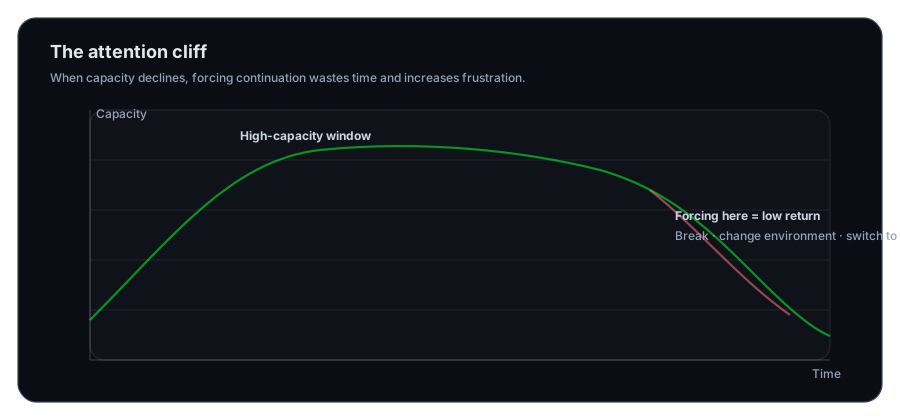
When attention decreases, forcing continuation produces problems:
- Poor comprehension — information enters your mind but doesn't integrate
- Higher frustration — you feel like you're working but making no progress
- Wasted time — you're studying but barely learning
The intelligent response is different: recognize when attention is declining and redirect it strategically.
Respecting attention limits prevents frustrationInformation Security: Too Much to Absorb at Once
Information security is vast. You won't absorb all of it at once. You'll return to topics repeatedly. You'll review what you've forgotten. You'll revisit concepts from new angles.
This is completely normal. This is how learning actually works.
The key is understanding how to divide your attention effectively across this vast landscape.
But here's the challenge: there's no universal formula for dividing attention correctly.
Attention Is Individual
Attention span isn't a fixed number. It varies based on:
- Your current emotional state
- Your circadian rhythm (time of day)
- Sleep quality the previous night
- Whether you've taken breaks
- Your physical environment
- The difficulty of the material
- Your interest level
- Your overall stress and anxiety
These factors are unique to you. What works for someone else might not work for you.
The only way to understand your attention is through personal experimentation and documentation.
Documenting Your Attention
Spend one week documenting your attention patterns:
For each study session, record:
- Your emotional state (calm, nervous, worried, happy, depressed, relaxed, etc.)
- Your day so far (in a word or two — rushed, relaxed, productive, chaotic, etc.)
- Place of work (home, library, coffee shop, etc.)
- Time of day
- Duration of study session
- Sleep from previous night (hours, quality)
- Breaks taken (when, how many, duration)
- Anything else you notice
Create a simple table or list. Make it easy to document quickly — you don't need detail, just data.
After one week, patterns emerge. You'll notice:
- "I focus best at 9am, after 8 hours of sleep, in the library"
- "My attention drops after 90 minutes, no matter what"
- "I focus better after a 15-minute break than a 5-minute break"
- "Studying after exercise gives me a 2-hour focused window"
These patterns are your personal attention profile.
warning
Don't try to force yourself into someone else's pattern. Your attention signature is unique. Discover it through experimentation and observation.
From Data to Strategy
Once you know your attention patterns, you can optimize around them:
If you focus best at 9am:
Schedule your most difficult, important learning for 9am. Use other times for review or easier material.
If your attention peaks around 90 minutes:
Study in 90-minute blocks. Take a real break afterward — 15-30 minutes, not just 5 minutes.
If you focus better in libraries:
Work there when possible. If you must work elsewhere, replicate the quiet, focused environment.
If exercise boosts your focus:
Exercise before learning sessions when you can.
But here's what's crucial: don't divide your attention time mathematically.
If your attention spans 60 minutes, you might think "I can do three 20-minute topics." This doesn't work. Attention switching carries costs. You lose context. You lose momentum. Your effective attention on each topic drops.
Instead, respect your attention span. Study one topic for your peak duration. Take a real break. Then begin again.
Experimentation and Optimization
Your attention profile isn't fixed. It changes with:
- Different study locations
- Different times of day
- Different types of material
- Different learning methods (reading vs. practicing vs. discussing)
- Music or silence
- Coffee or no coffee
- Morning or evening
Experiment. Try different configurations. Notice what helps and what hinders.
Make studying enjoyable. If you're miserable, your attention collapses. If you're engaged, attention sustains naturally.
This isn't "soft" advice. This is practical neuroscience. Your brain focuses better when you're comfortable and enjoying yourself.
Comfort and enjoyment extend attention spanThe Danger of Force
Here's something critical: don't force yourself to focus on a topic when attention is declining.
This has negative effects:
- You learn poorly
- You build frustration and resentment toward the material
- You condition yourself to dislike learning
- You waste time and energy
This is especially important in security learning, where frustration is easy to trigger. Complex topics, challenging concepts, difficult tools — all can create frustration quickly.
When you feel attention declining and frustration rising, stop. It's not failure. It's your brain telling you something important: "I need a break. I need a different environment. I need different material. I need to rest."
Listen to that signal.
Attention vs. Focus vs. Concentration
These three work together:
- Attention — your perception of a topic with heightened interest (automatic, subconscious)
- Focus — your deliberate alignment toward a goal (conscious, directional)
- Concentration — active maintenance of attention on a topic (conscious effort)
You might focus on "mastering penetration testing" (goal-oriented). Within that focus, your attention is on "SQL injection" (interest-oriented). Your concentration maintains attention on SQL injection despite distractions.
When attention naturally declines, concentration becomes forced. Forcing it produces poor results. Better to redirect focus and restart concentration.
Readiness as a Prerequisite
Before beginning any study session, ask yourself:
- Am I emotionally ready? (Not anxious, not distracted)
- Am I physically ready? (Rested, fed, not exhausted)
- Is my environment right? (Comfortable, quiet, conducive to focus)
- Do I have the time for a meaningful session? (Not rushed)
If the answer to any is "no," don't force it. Adjust. Wait. Prepare yourself properly.
Make sure you feel comfortable and ready to learn new things.This isn't indulgence. It's smart optimization. A properly prepared, comfortable learner absorbs far more in 60 focused minutes than a tired, uncomfortable learner in 120 forced minutes.
What is attention?
What factors influence your attention?
What is concentration?
What happens when you force yourself to continue studying after attention declines?
Why is there no universal formula for dividing attention?
What should you document to understand your attention patterns?
How long should you document your attention patterns?
If your attention spans 60 minutes, can you split it into three 20-minute topics?
What should you do if attention is declining and frustration is rising?
What does 'make sure you feel comfortable and ready to learn' mean?
Exercise 1 — Build a distraction map
For one day, note every time you lose focus:
- What triggered it?
- What did you switch to?
- How long did it last?
Then choose one control to implement (blocker, timer, environment change).
Question 1 — What does it mean to “train attention”?
Next Lesson
With attention optimized, the next lesson explores comfort zones and strategic discomfort for growth.
Next: Comfort Zones