What Is an APT?
Most cyberattacks are fast and opportunistic. A hacker finds a vulnerability, exploits it quickly, steals What they can, and moves on. The goal is quick profit.
An Advanced Persistent Threat (APT) is fundamentally different. It's a sophisticated, long-term operation where attackers gain access to a network and remain hidden for extended periods—sometimes months or years. APTs are the opposite of quick theft: they're patient, methodical, and strategic.
APTs are typically carried out by:
- Nation-states — Governments conducting espionage, cyber warfare, or infrastructure sabotage
- Organized crime syndicates — Well-funded criminal organizations targeting high-value targets
- Corporate competitors — Well-resourced organizations seeking competitive intelligence
- Hacktivists — Ideologically motivated groups with significant resources and skills
APT attackers have resources that most cybercriminals lack: patience, funding, technical expertise, and strategic planning.
Key concept
For penetration testers: APT-style testing simulates sophisticated, long-term attacks. You might test whether organizations can detect persistent backdoors, whether lateral movement is possible, or whether data exfiltration can succeed. APT testing requires deep technical knowledge, careful authorization, and understanding of advanced attack techniques.
Why APTs Are Different
APTs differ fundamentally from other attacks:
Sophistication
APTs employ advanced techniques:
- Zero-day exploits — Vulnerabilities unknown to vendors, giving attackers an advantage
- Custom malware — Malware specifically written for the target, not available on the internet
- Living off the land — Using legitimate system tools (PowerShell, WMI) to avoid detection
- Advanced evasion — Techniques to avoid triggering security tools and alerts
Time Horizon
APTs are patient. Attackers may spend weeks or months in reconnaissance before attacking. They may remain in networks for a year or more after initial compromise. They're not in a hurry.
Resource Requirements
APTs require:
- Skilled personnel — Teams of experienced security researchers and malware developers
- Infrastructure — Command-and-control servers, backup systems, redundant communications
- Funding — Significant financial resources to maintain operations over extended periods
- Operational security — Elaborate procedures to avoid being discovered
Strategic Objectives
APTs pursue high-value goals:
- Intellectual property theft — Trade secrets worth millions or billions
- Espionage — Government or military intelligence with strategic value
- Infrastructure sabotage — Disrupting power, water, communications systems
- Political influence — Interfering with elections or diplomatic operations
The objectives are strategic and long-term, not quick financial gain.
The APT Lifecycle
APTs follow a predictable progression:
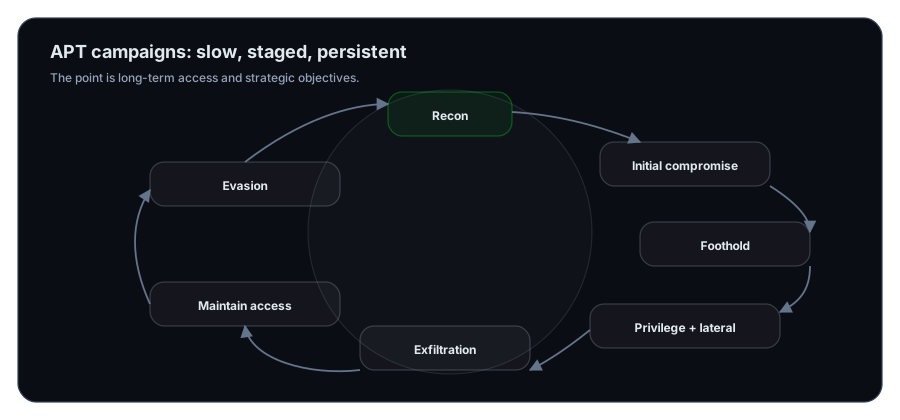
Stage 1: Reconnaissance
Before attacking, APT actors meticulously study targets:
Target selection — Identifying organizations with valuable assets (technology companies, defense contractors, government agencies, financial institutions).
Information gathering — Researching:
- Organization structure and personnel
- Technologies and systems used
- Security measures in place
- Employees and their roles
- Network architecture
- Publicly available information (job postings, LinkedIn, company websites)
Vulnerability research — Identifying potential entry points:
- Known vulnerabilities in systems used by the target
- Outdated software with known exploits
- Security gaps in configurations
- Human vulnerability (who's gullible to phishing?)
This stage can last weeks or months. Thorough reconnaissance increases attack success.
Stage 2: Initial Compromise
Once targets are identified and preparation is complete, attackers gain initial access:
Spear phishing — Highly targeted emails to specific employees, often appearing to come from trusted sources or using information gathered during reconnaissance. The goal is to get an employee to click a link or download a file containing malware.
Exploit vulnerabilities — Attacking unpatched systems or software with known vulnerabilities.
Supply chain compromise — Compromising a vendor or supplier used by the target (like SolarWinds in 2020), then delivering malware through legitimate updates.
Physical access — Sometimes attackers gain physical access to facilities and install hardware implants or USB-based malware.
Credential theft — Stealing valid credentials through various means, then using them to access systems directly.
The goal is establishing a foothold—getting malware running on a system inside the network.
Stage 3: Establish Persistence
Once inside, attackers ensure they can maintain access even if initial entry is discovered:
Install backdoors — Creating hidden access mechanisms so the attacker can reconnect later without exploiting vulnerabilities again.
Create administrative accounts — Establishing accounts with high privileges, giving full control.
Install rootkits — Malware that deeply embeds in systems, hiding from standard detection tools.
Modify system files — Altering legitimate programs to include attacker-controlled code, persisting across reboots.
Establish C2 communication — Setting up encrypted communication channels with the target's network, allowing the attacker to send commands and receive stolen data.
This stage is critical. If attackers can persist, they own the network indefinitely.
Stage 4: Lateral Movement
With a foothold established, attackers expand access:
Privilege escalation — Exploiting vulnerabilities or misconfigurations to escalate from user-level to administrative access.
Network mapping — Understanding the network: what systems exist, how they're connected, where valuable data is located.
Credential harvesting — Stealing credentials from compromised systems to access other systems.
Exploiting trust relationships — Using the fact that internal systems often trust each other. If system A trusts system B, and system B is compromised, the attacker can use that trust to access system A.
The goal is reaching high-value systems (databases with customer data, intellectual property repositories, financial systems).
Stage 5: Data Exfiltration
Once the attacker reaches valuable data, they steal it:
Data collection — Identifying and gathering valuable files from compromised systems.
Compression and encryption — Making stolen data smaller and unreadable to anyone intercepting it.
Stealthy transfer — Transferring data over encrypted channels to avoid detection. Large transfers might happen over days or weeks to avoid triggering alerts about unusual data movement.
Coverage — The attacker might modify logs or delete activity records to hide their tracks.
This stage might take weeks or months. Attackers often steal massive amounts of data—gigabytes or terabytes.
Stage 6: Persistence and Return
The attacker maintains access for future operations:
Multiple backdoors — Installing several different backdoors so if one is discovered and closed, others remain.
Backup access methods — Creating multiple ways to regain access (different malware, different credentials, different network paths).
Operational security — Maintaining low visibility, avoiding actions that trigger alerts, remaining patient.
The attacker might extract data over many months, establish multiple backdoors, and lay groundwork for future attacks (like installing malware that will activate when ordered).
The SolarWinds APT Case Study
In December 2020, one of the most significant APT attacks in history became public: the SolarWinds incident.
The Attack
Target: SolarWinds, a company providing Orion network management software used by thousands of organizations, including U.S. government agencies and Fortune 500 companies.
Method: Attackers infiltrated SolarWinds and inserted malicious code into the Orion software. When customers (unknowingly) installed a routine software update, the malware was installed on their systems.
Scope: Potentially 18,000 organizations were affected, including:
- U.S. government agencies (Treasury, Commerce, Homeland Security, Defense)
- Intelligence agencies
- Fortune 500 companies
- Energy and utility companies
- Critical infrastructure operators
Dwell time: The attackers remained undetected for months, stealing sensitive data from numerous organizations.
The Impact
- Espionage: Intelligence agencies believed the attackers were state-sponsored (suspected: Russian SVR)
- Data theft: Sensitive government communications and information were stolen
- Escalation: The attack prompted government responses and international sanctions
- Trust damage: Organizations lost confidence in software supply chains
- Recovery costs: Billions spent on investigation, remediation, and strengthening security
The SolarWinds attack demonstrated how sophisticated APTs can compromise trusted software supply chains and affect thousands of organizations at once.
APT Impacts
APTs cause severe, multifaceted damage:
Financial Loss
Direct theft — Stealing intellectual property worth millions or billions.
Response and recovery — Investigation, remediation, system rebuilds, and security improvements cost millions.
Operational downtime — Disrupted operations while responding to attacks.
Lost business — Customers migrating to competitors due to breaches.
Stock impact — Public companies see stock prices decline after APT disclosure.
A major APT attack can cost an organization $100 million or more.
Intellectual Property Loss
Stolen research, designs, source code, or trade secrets give competitors advantages that persist for years. The organization's competitive edge is permanently compromised.
Reputational Damage
APT breaches erode customer trust. Customers worry their data was compromised. The organization's reputation as a secure, trustworthy provider is damaged. Long-term revenue decline follows.
National Security Impact
APTs targeting government agencies or critical infrastructure pose serious national security risks:
- Stolen military secrets aid adversaries
- Compromised infrastructure could be sabotaged during conflict
- Espionage shifts intelligence balance
- Economic espionage weakens competitive position
Regulatory and Legal Consequences
Compliance violations — Breaches violate regulations like GDPR, HIPAA, and others, resulting in massive fines.
Lawsuits — Customers whose data was breached file lawsuits for damages.
Mandatory disclosures — Organizations must publicly disclose breaches, inviting additional scrutiny and liability.
Sanctions — Governments impose sanctions on countries whose intelligence agencies conducted attacks.
Operational Disruption
Discovering and responding to APTs requires taking systems offline, disrupting operations. Recovery takes weeks or months.
Psychological Impact
The realization that sophisticated nation-states or criminal organizations have operated undetected in your network is deeply unsettling. Employee morale suffers. Trust in management declines.
Defending Against APTs
APT defense requires advanced capabilities and strategic thinking:
Prevention
Vulnerability management — Aggressively identifying and patching vulnerabilities. APTs exploit unpatched systems, so timely patching is critical.
Security awareness training — Sophisticated spear phishing is hard to detect, but training improves recognition. Emphasize that APTs target high-value employees.
Network segmentation — Dividing networks into zones so compromise of one zone doesn't give access to all. Critical systems are heavily protected and isolated.
Strong access controls — Multi-factor authentication, least privilege access, and strong password policies reduce compromised credential impact.
Supply chain security — Vetting vendors, monitoring suppliers, and verifying software integrity before deployment.
Detection
Advanced threat detection — Tools analyzing behavior, not just signatures. Detecting unusual lateral movement, data exfiltration, or command-and-control communication.
Threat hunting — Security teams proactively searching for indicators of compromise rather than waiting for alerts. Threat hunting can find APTs that evade automated detection.
Continuous monitoring — Log collection, analysis, and monitoring. Detecting unusual activity across systems and timeframes.
Incident response readiness — Teams, procedures, and tools ready to respond quickly when APTs are discovered.
Response and Recovery
Containment — Isolating compromised systems to prevent further damage or data theft.
Investigation — Determining what the attacker accessed, how they got in, what tools they used, and how long they were present.
Eradication — Removing all attacker access, backdoors, and malware.
Recovery — Restoring systems from clean backups, rebuilding compromised systems, and verifying security.
Forensics and intelligence — Collecting evidence, understanding the attack, and sharing intelligence with law enforcement and other affected organizations.
The APT Reality
APTs are a persistent, evolving threat:
- Frequency — Major APTs occur regularly against government, finance, technology, and defense sectors
- Sophistication — Attacks are becoming more sophisticated, using newer techniques and zero-days
- Dwell time — APTs often remain undetected for months or years. Average dwell time is 200+ days
- Resource requirements — Only well-funded organizations can conduct APTs, limiting the threat to nation-states and major criminal organizations
- Global scale — APTs target organizations worldwide, with impacts crossing national borders
- Evolution — As defenses improve, APT techniques evolve to bypass them
Organizations must accept that sophisticated attackers may compromise their networks. The goal shifts from "prevent compromise" to "detect quickly and respond effectively."
What is an Advanced Persistent Threat (APT)?
Who typically conducts APTs?
What are common APT objectives?
What is the first stage of an APT attack?
What is the purpose of the Persistence stage in APTs?
What is Lateral Movement in APT attacks?
What was the SolarWinds APT attack?
Why is the SolarWinds attack considered a supply chain attack?
How long do APTs typically remain undetected?
What does 'threat hunting' mean in APT defense?
Exercise 1 — Map an APT-style campaign to detection points
Pick a hypothetical campaign with 3 phases (initial access, persistence, lateral movement) and write:
- One detection signal per phase
- One defensive control per phase
Question 1 — What differentiates an APT from commodity malware?
Next Lesson
Now that you understand the most sophisticated threat actors, it's time to explore the diverse landscape of all threat actors and their threat profiles—understanding adversary types helps organizations prioritize defenses.
Next: Adversaries and Threat Profiles