Who Are the Adversaries?
Understanding attackers is as important as understanding defenses. Adversaries range from individual hobbyists to nation-state intelligence agencies. Each type has different capabilities, objectives, and methods.
A Threat Actor is any individual or group conducting cyberattacks. Threat actors can be:
- Organized teams — Groups of individuals with specialized skills collaborating on sophisticated attacks
- Solo operators — Independent individuals conducting attacks autonomously
- Nation-states — Government-sponsored attackers with intelligence agencies or military units
- Organized crime — Criminal organizations conducting attacks for profit
- Hacktivists — Ideologically motivated individuals or groups conducting attacks for causes
- Script kiddies — Unskilled individuals using pre-built tools and techniques, lacking deep technical knowledge
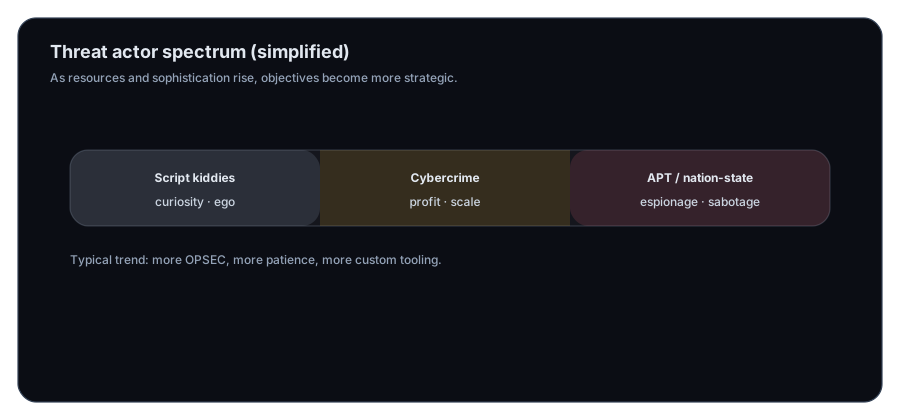
Each threat actor type has different levels of sophistication, resources, and objectives.
Key concept
For penetration testers: Understanding threat actor profiles helps you conduct realistic testing. You might simulate tactics used by specific threat actor groups, test organizational readiness against particular adversary types, or document findings in threat actor-specific frameworks. Knowing adversary capabilities and methodologies informs comprehensive security assessments.
Organized Threat Actor Teams
Professional Threat actor teams are Organized like legitimate businesses. They have specialized roles, hierarchies, and division of labor. This specialization makes them more effective than solo operators.
Key Roles in Threat Actor Teams
Team Leader / Strategist
- Sets objectives and strategies
- Coordinates team members
- Plans attack phases
- Makes critical decisions
- Reports to sponsors (for nation-state or organized crime operations)
The leader ensures all efforts align toward the strategic objective.
Reconnaissance Specialist
- Gathers information about targets
- Identifies vulnerabilities and weak points
- Uses OSINT (open-source intelligence): public websites, job postings, LinkedIn, DNS records
- Conducts social engineering reconnaissance
- Maps network infrastructure
- Studies employee behavior and organizational processes
Reconnaissance determines attack success. The more the specialist learns, the better the chances of breaching defenses.
Exploit Developer / Hacker
- Creates custom malware and exploits
- Develops tools for breaking into systems
- Exploits software vulnerabilities
- Creates backdoors and persistent access mechanisms
- Adapts existing exploits for specific targets
Expert programmers make attacks effective and difficult to defend against.
Network Specialist
- Navigates complex network infrastructure
- Performs lateral movement through networks
- Escalates privileges
- Maps network topology
- Identifies and exploits trust relationships between systems
- Understands network security controls and how to bypass them
Network specialists expand access from initial entry to critical systems.
Social Engineer
- Manipulates people into revealing information
- Crafts convincing phishing emails
- Conducts pretexting calls
- Performs physical security testing
- Exploits human psychology and trust
Social engineers often provide the easiest entry into systems.
Data Analyst
- Processes stolen information
- Extracts valuable intelligence from data
- Identifies high-value information (trade secrets, financial data, personal records)
- Packages data for sale or leverage
- Determines what information is most valuable
Data analysts ensure stolen information is processed and monetized.
Exfiltration Specialist
- Steals data from target networks
- Uses encrypted channels to avoid detection
- Employs obfuscation techniques to hide data transfers
- Evades detection systems
- Covers tracks and removes evidence
Exfiltration specialists ensure stolen data successfully leaves the network without being detected.
Team Strengths
Organized teams are formidable because:
- Specialization — Each member becomes expert in their role
- Division of labor — Dividing work increases efficiency
- Redundancy — If one member is unavailable, others continue
- Coordination — Complex attacks require multiple people working together
- Resources — Teams share funding, infrastructure, and tools
A well-organized threat actor team can conduct sophisticated, multi-stage attacks that would be impossible for individuals.
Solo Threat Actors (Lone Wolves)
Not all Threat actors work in teams. Solo operators (lone wolves) work independently, conducting attacks autonomously.
Characteristics of Solo Operators
Diverse skill sets — Solo operators must be generalists, capable of reconnaissance, exploitation, data exfiltration, and operational security.
Limited resources — Without organizational support, solo operators have less funding, fewer tools, and less infrastructure.
Self-motivation — They're driven by personal interests, ideological beliefs, or financial need rather than organizational objectives.
Flexibility — Operating alone, they can adapt quickly without needing to coordinate with others.
Detection challenges — Solo operators might leave less evidence than teams, or conversely, their lack of sophistication might leave more obvious traces.
Threat Levels
Solo operators range from:
- Script kiddies — Using pre-built tools with limited understanding, posing minimal threat
- Self-taught hackers — Teaching themselves through online resources, capable of significant attacks
- Specialized experts — Former security professionals or highly skilled programmers, equally dangerous to organized teams
A skilled solo operator can be as dangerous as a team, though typically with different objectives (less likely to conduct sophisticated long-term espionage, more likely to pursue individual financial gain or ideological goals).
Threat Actor Capabilities Matrix
Threat Actor sophistication varies dramatically:
| Actor Type | Sophistication | Resources | Typical Objectives | Threat Level |
|---|---|---|---|---|
| Script Kiddies | Low | Minimal | Experimentation, small-scale theft | Low |
| Organized Cybercrime | High | Significant | Financial theft, ransomware, data sales | Very High |
| Hacktivists | Medium | Limited | Disruption, ideological messaging | Medium |
| Nation-State APTs | Very High | Unlimited | Espionage, infrastructure sabotage, warfare | Critical |
| Insider Threats | Medium to High | Access only | Data theft, sabotage, financial gain | Very High |
| Solo Operators | Variable | Minimal | Financial, ideological, experimental | Low to Very High |
Threat level doesn't always correlate with sophistication. An insider threat with limited technical skills but legitimate access can be highly damaging.
Threat Actor Motivations
Understanding what drives Threat Actors helps organizations anticipate attacks:
Financial Motivation
Attackers seeking profit:
Direct theft — Stealing money directly from financial systems, cryptocurrency wallets, or bank accounts.
Data theft and sale — Stealing valuable data (credit cards, medical records, trade secrets) and selling it on the dark web.
Ransomware — Encrypting critical data and demanding payment for decryption keys.
Fraud — Using stolen credentials or identities for fraud schemes.
Extortion — Demanding payment in exchange for not releasing data or causing disruption.
Financial motivation is the most common driver, affecting both individuals and organizations worldwide.
Espionage
Attackers seeking intelligence:
Government espionage — Foreign governments stealing classified information, military secrets, or diplomatic intelligence.
Corporate espionage — Competitors stealing trade secrets, research, or business strategies.
Competitive advantage — Information providing economic, political, or military advantages.
Espionage attacks often target governments, defense contractors, technology companies, and research institutions.
Disruption
Attackers seeking to cause chaos:
Service disruption — DDoS attacks making services unavailable.
Data deletion — Destroying or corrupting data to disrupt operations.
Infrastructure sabotage — Damaging power grids, water systems, or communication networks.
Disruption attackers might be hacktivists, nation-states (in cyber warfare), or disgruntled insiders.
Ideological
Attackers driven by belief:
Activism — Attacking organizations whose practices they oppose (environmental groups attacking oil companies, human rights activists attacking oppressive governments).
Political — Influencing political outcomes through election interference or misinformation.
Religious — Attacking organizations or individuals whose beliefs they oppose.
Social causes — Advocating for various social movements.
Ideological attackers often make their motivations public, "leaking" their attacks to the media or taking public credit.
Revenge
Attackers driven by anger:
Disgruntled employees — Attacking former employers to cause damage or expose wrongdoing.
Revenge against organizations — Attacking companies or governments seen as having wronged them personally.
Personal vendettas — Attacking individuals in disputes.
Revenge-motivated attacks are often less sophisticated but can be particularly destructive because the attacker is emotionally driven.
Threat Actor Tactics and Methods
Different Threat Actors use different tactics based on capabilities and objectives:
"Loud and Fast" Methods
Less sophisticated attackers or those not concerned with detection:
- Brute-force attacks — Trying many password combinations, obviously attempting to break in
- Worm-like malware — Self-propagating malware spreading aggressively across networks
- Public exploitation — Using well-known vulnerabilities and exploits available to everyone
- Obvious theft — Large-scale data downloads that trigger alerts
These methods are noisy—they generate alerts and attract attention.
"Low and Slow" Methods
Sophisticated attackers avoiding detection:
- Social engineering — Patient, targeted manipulation of individuals
- Living off the land — Using legitimate system tools to avoid detection
- Encrypted communication — Hiding command-and-control communications
- Slow data exfiltration — Stealing data gradually over weeks or months
- Low-noise access — Moving carefully through networks, minimizing activity that triggers alerts
These methods are stealthy—they're designed to avoid immediate detection.
The choice of tactics depends on the threat actor's sophistication and whether detection is a concern. Nation-state APTs use low-and-slow tactics. Ransomware operators might use loud-and-fast tactics because they want rapid encryption before organizations respond.
Profiling Threat Actors
Security teams develop Threat actor profiles to anticipate attacks:
Attack patterns — What methods do they typically use?
Target preferences — Which sectors, company sizes, or individuals do they target?
Objectives — What are they trying to accomplish?
Capabilities — What level of sophistication do they demonstrate?
Indicators of Compromise (IOCs) — What technical signatures (malware hashes, IP addresses, domains) are associated with them?
Geographic origin — Where are they likely located?
Timing — When do they typically attack? (Business hours, off-hours, specific dates?)
Operational security — How do they avoid detection?
Organizations use threat actor profiles to:
- Identify attacks matching known profiles
- Anticipate attack vectors based on profiles
- Allocate resources based on threat likelihood
- Develop defenses targeted to specific adversaries
For example: A financial services company might profile ransomware operators targeting banks and prepare specific defenses. A government agency might profile APT groups targeting their sector and develop specialized detection.
Defending Against Specific Threat Actor Types
Different Threat Actors require different defensive approaches:
Against script kiddies: Basic security (patching, antivirus, firewalls) is often sufficient.
Against organized crime: Advanced detection (behavioral analysis, threat hunting), rapid response, and resilience (backups, business continuity) are critical.
Against nation-state APTs: Expecting compromise becomes reasonable. Focus shifts to detection, containment, and recovery rather than prevention alone.
Against insider threats: Access control, monitoring, and cultural factors matter more than external defenses.
Effective security strategies account for the most dangerous threat actors likely to target the organization, not just generic threats.
Staying Informed
The threat landscape constantly evolves as attackers innovate and new groups emerge. Organizations stay Informed through:
- Threat intelligence — Sharing information about known threat actors, their tactics, and indicators
- Industry information — Sector-specific threat reports highlighting threats relevant to their industry
- Security advisories — Notifications about newly discovered vulnerabilities and active exploits
- Conference and research — Learning from security researchers and incident responders
Understanding the current threat landscape—who's attacking, how, and why—is essential for building effective defenses.
What is a Threat Actor?
What are the key roles in an organized threat actor team?
What is a Reconnaissance Specialist's role?
What are 'solo operators' or 'lone wolves' in cybersecurity?
What is OSINT in the context of cyber reconnaissance?
What are the primary motivations for threat actors?
What is the difference between 'loud and fast' and 'low and slow' attack tactics?
Why do threat actor teams have specialized roles?
What is a threat actor profile?
How do organizations use threat actor profiles?
Exercise 1 — Create two threat profiles
Create two adversary profiles (e.g., ransomware group vs insider) with:
- Motivation
- Typical capabilities
- Preferred targets
- Likely attack paths
Question 1 — How do threat profiles improve security decisions?
Next Lesson
Now that you understand the diverse landscape of threat actors, it's time to explore how organizations respond offensively—Red Team operations and authorized attack simulations.
Next: Red Team Operations & Offensive Security